(June 25th – July 2nd, 2026)
-“So first we wash in the fountain of ablution as an act of wudu, which is a ritual cleansing the hands, face, and feet with water before prayers.”
Ibrahim, my local contact introduced to me by my affable innkeeper Ensar of the Ziyagil Kongi hotel, instructed me on proper technique as I took off my shoes and methodically washed my hands, face and feet in the ornate pavilion housing several fountains outside the impressive 15th century Bayezid II mosque in the heart of Amasya.
-“Everyone, of all classes, washes from the same water. And it cleanses the mind before worship”
-“Now, the muezzin will soon make the call to prayer. Let’s go say hello.”
I follow him across the front courtyard to the carve out in the façade of the mosque where an immaculately manicured man introduced himself and made a friendly greeting. Moments later he most eloquently initiated a passionate performance singing from deep within his soul into a microphone that would be broadcast throughout the entire city and valley.
In what I had in prior days in Türkiye assumed were prayers themselves, were in fact, calls, or adhan, to prayer, notably issued five times a day based on the positioning of the sun in the sky, and collectively referred to as the salah, in every village and city throughout the country and the Muslim world beyond. Specifically, they are the Fajr (dawn), Dhuhr (midday after the sun passes its zenith), Asr (late afternoon when an object’s shadow matches its actual length), Maghrib (sunset), and Isha (last twilight). All the prayers are intended to ensure the day begins with acknowledgement of God, that breaks are taken periodically from worldly distractions to remind believers of as much, and that the day concludes with thankfulness for divine provision.

Upon conclusion of the moving incantation, people gathering outside the mosque began shuffling inside, importantly removing their shoes first. They then aligned themselves uniformly along the patterns of the interior decorative carpet appropriating adequate space between them. Notably, women would take to a separate space at the back of the mosque, behind the men. Islam forbids the sexes praying together given the physical nature of the process, and the stated rationale is to ensure focus on God and avoid distraction during the prayer. In part, I can see where the logic comes from, even if it is still an odd construct to accept on the surface from a Western mindset.
Ibrahim signaled to me to follow him to an elevated balcony along with the muezzin. He instructed me to situate myself in the back of that space, behind him, the muezzin, and a couple others.
The imam then began the formal prayers at the head of the mihrab and the believers followed along reciting and engaging in the ritual of prostration, standing, bowing, and kneeling to the ground in repetitive sequence in the direction of Mecca, and the site of the Kaaba, the holiest shrine in Islam.

I participated in a respectful manner to emulate the actions in an effort to understand the process.
After prayers, Ibrahim elaborated on the significance of the various steps that they had in engaged in and the significance of each. For example, the act of prostration to the ground, or sujud, signifies several elements of humility, as I will paraphrase further.
Kneeling and touching the head to the ground denotes total submission to God and positions the face and head at the lowest physical level to represent humility and obedience. It is thought a believer is closest to God in this position and serves as a reminder that humans came from the Earth and will return to it. Interestingly, it is also considered that the head holds the thoughts and ego of the human and touching it to the Earth surrenders control back to God.
-“Lastly, as we finish prayer, we must acknowledge Raqaeb and Atib, by looking both to the right and the left of each shoulder.”
Raqaeb and Atib are considered angels residing in our presence, but one records good deeds while the other records the bad ones, yet gives a grace period to register them so that the one that commits them may recognize as much and repent in time. On the final Day of Judgment, the Book of Deeds and accounting is added up. One would then hope that Raqaeb has a more voluminous account of deeds in favor in life than Atib.
In one day, I had just learned more about Islam than in my entire life up to that moment. Not out of a consideration for conversion, but rather out of an earnest desire to understand better the culture and practice of a people amounting to two billion, or 25% of the world’s population, of which I ashamedly knew very little in practice.
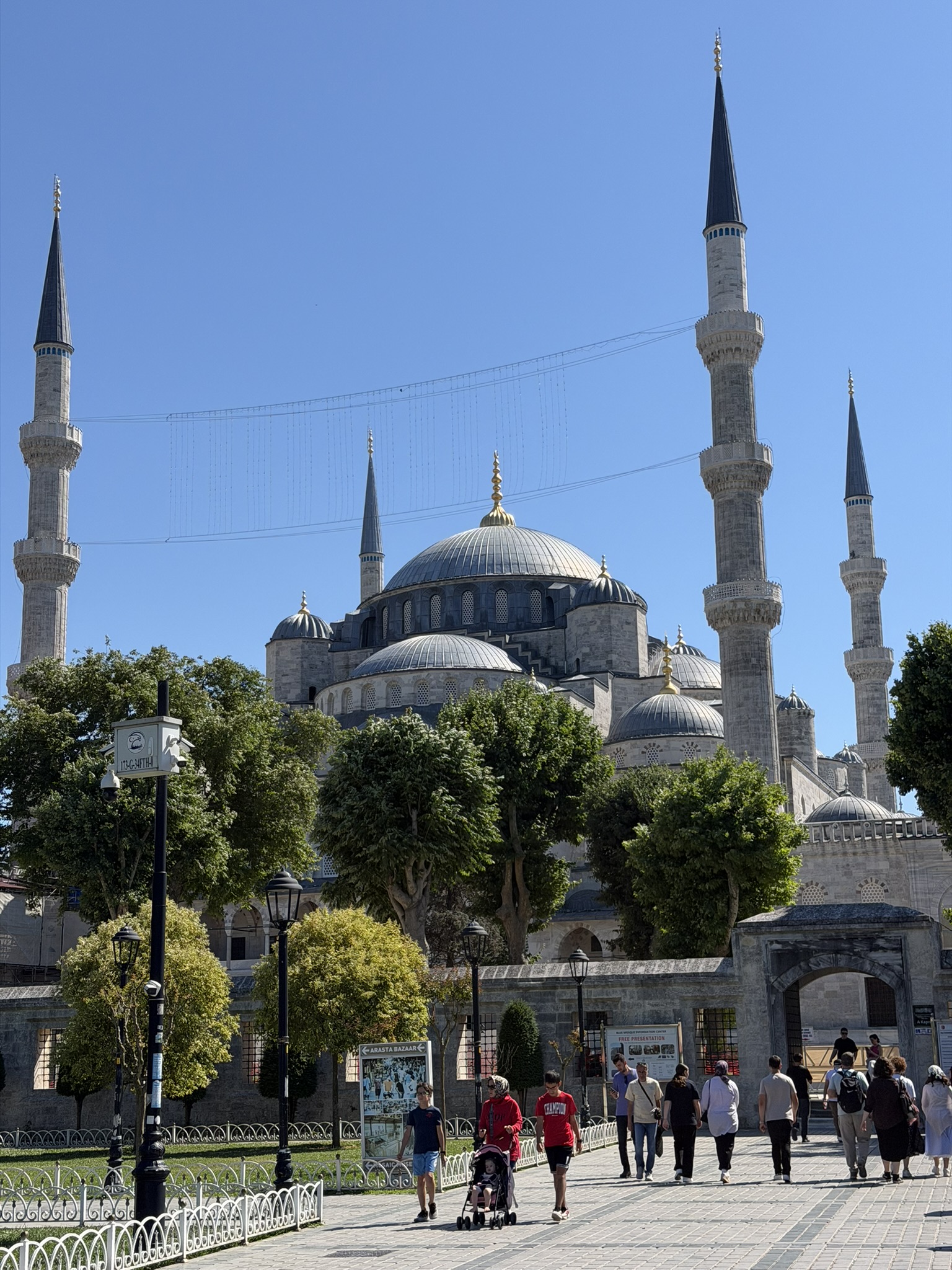
Beginning in Sofia, Bulgaria, where I entered into the first mosque of my life, I had now been traveling in Türkiye for five days and the presence of Islam was pervasive. Türkiye is a secular country, rather than a theocracy, and it was quite the juxtaposition on my first metro ride in Istanbul to observe half the train car of women dawning full burqas next to the other half in typically revealing Western-style dress. Having already admired the ornate décor of Byzantine mosaics and paintings within the Eastern Orthodox churches of Eastern Europe, I had now been marveling at the absolute beauty of mosques in Istanbul and now Amasya, a little known provincial wonder in central Türkiye with a rich history spanning nearly 7,000 years. The Hagia Sophia in Istanbul, one of the largest and most storied religious buildings in humanity, prevented non-believers from entering the base floor and the simply magnificent “Blue mosque” nearby similarly limited entry of tourists beyond a certain point.
My experience that day with Ibrahim began with a friendly conversation that morning with Ensar in which I inquired if there was a way for a non-believer to enter and participate in the prayers at the mosque in a respectful and honorable way, in an effort to understand the practice and people better. He assured me he knew the right guy.
While perhaps there was a mild hope of securing my conversion to the faith, I gathered that Ibrahim was more than anything proud to have an opportunity to share his faith and culture with someone that wanted to listen. Having come of age around the time of 9/11 in America, I think it’s a fair assertion to acknowledge a particular stigma and taboo from my generation, or in the mainstream culture of America generally, regarding Islam, as it had been made awash with an unfair association with radicalism and terrorism.

As a student of life and history, I felt fairly inadequate when it came to terms of understanding the religion. In my defense, I had never really traveled in this part of the world. But I always desire to know more and thought I never had a better moment until now to make my own observations.
What I saw was an exceptionally devout people reveling in an incredible ornate and cultured religious space. Rightly or wrongly, in comparison with the relative decline in Western participation in Christianity and religion in general, I could not help but be impressed by the seemingly near universal participation of the local populace in their faith and its rituals. It was powerful, and beautiful, regardless of whether my personal beliefs align or not.
Later back at the inn, Ensar had put the World Cup on in the café at my request as I could not find anywhere in the town with the game on, perhaps because bars were not prevalent in this rural province. Eventually, several village policemen began gathering to watch the match, as well. Ensar soon made mention that I had gone to the mosque that day. The policemen took great interest in this and began to readily embrace me and share more with me about their pride in their faith as a wholesome way of living. One in particular went out of his way to explain the principles of benevolent practice of Islam while intent on insisting that his faith did not make him a terrorist. I assured him I understood this without explanation. Regardless, I could tell that my interest and participation in the local culture that day had garnered for me great respect among the folks that Ensar would speak with. It was not common that an American visited their city. It was perhaps more rare that one seemed to take an interest in understanding their culture and religion to such an extent.
And there is an important point there. We all want to be heard and understood. It’s a universal human need.
And I am not writing now to promote Islam as a faith nor find critiques of it from my observations, rather underscore that there is a lot to be achieved in life if we open ourselves to understand the Other side, whether that is in personal relationships, the business world, or international relations. We must all strive to form our beliefs based on open engagement and actual non-judgmental observation rather than simply what we have come to believe over time as part of a standard worldview shaped by our exposure to media and prevailing established cultural disposition.
Perhaps most importantly, I feel that simply acknowledging and giving respect to that which makes those differ from ourselves is immensely important to being heard and understood ourselves. It acts as a critical basis for any meaningful conversation and engagement to earn ultimate respect.
How can we attempt to speak the same language and reach consensus if we cannot understand the foundations forming each of our points of view?
—
Amasya formed the highlight of my week-long journey across Türkiye towards Georgia. A wholly intimate experience in a place not well-trodden by foreigners. In addition to the hospitality from Ibrahim, who later treated me to dinner after our walk about and time at the mosque, I delighted in apple tea for which the city is famous and marveled at the impressive tombs of the Kings of Pontus. The tombs tower above the Yeşilırmak river and old town, which serve as a 2,000 year old monumental relic to several prior kings dramatically carved out of the limestone mountain wall between 8 to 15 meters (25 – 50 ft) tall a couple hundred meters above the city. On top of the Harşena mountain, a castle fortress originally dating back to the same era and in use until the 18th century provided sweeping views of the city. The evenings proved delightful to walk along the river and observe a joyful nightlife of families and friends strolling about until midnight, all fueled entirely sans alcohol.

—
I had rightly allocated most of my time in the country though to Istanbul, easily one of the great cities of the world as it straddles East and West and the continents of Europe and Asia. There must be no shortage of travel blogs and online guides detailing the sights and history of that magnificent, yet honestly somewhat overwhelming city, but I can agree that it merits addition to any traveler’s life list.
Ferrying across the Bosporus to the various tightly-knitted neighborhoods that climb through labyrinthine alleyways up into the hills and walking along coastal promenades with stops to drink çay were memorable. The history is far too profound to attempt any summary here, but its manifestation in the primary tourist sites of the Topkapi Palace, Sultanahmet Square, Blue mosque, Hagia Sophia, Galata tower, and more, were at a minimum mind blowing. While I was a bit disappointed to see the grandeur of the Hagia Sophia marred in part by ongoing renovation-related scaffolding and by limited interior access, the Blue mosque was beyond impressive, and the Topkapi palace was a jeweled deep dive into Ottoman legacy and life with exceptional architecture and insights. I spent hours there and could not have imagined passing on the opportunity.

Lastly, I stopped for two nights in Trabzon in eastern Türkiye along the Black Sea. I will admit that unplanned, spontaneous open-ended travel does not always lead to a 1,000% batting average in discovering hidden gems and memorable experiences. Upon arrival, I quickly discerned that the brief Google images that caught my attention enough to warrant a travel stop were misleading to say the least as I observed an industrial port city rather than an idyllic seaside village. Apparently those photos are from a website promoting a tour a couple hours away.
Recognizing my folly, I determined I should book a tour the following day to notable regional sites to salvage my time staying in the city, which laughably led to further disappoint and a tourist van day trip from hell, complete with endless trinket and café stops and a guide that did not even accompany us into the monastery that served as the first, and primary stop of the tour.

On the upside, the hours in the van did take us to enough really pretty areas higher up in the mountains of northeastern Türkiye to appreciate the region’s beauty, as well as affording time to commiserate with Jin, a fairly interesting fellow from China who has been working internationally in construction management for his entire career and whom currently resides in Serbia. Once back in Trabzon, we enjoyed a few beers together talking about worldly travels and formative experiences while enjoying a bit of live music and a World Cup match. He loaded me with tips for China and we traded a few Buddhist and eastern philosophical parables to round out the evening.

The next morning I caught a minivan towards the border at Sarp/Sarpi, and besides being conspicuously called out by the Georgian border guard to his colleagues on the other side of the large, and busy, immigration hall as an American, he let me through after extensive page flipping and needless pausing. I guess they do not get many Americans at this crossing.
I had made it to Georgia on July 2nd. One day behind my original intention after one and half months traversing northern and eastern Europe by land. It was now time to slow my roll and gear up for extensive hiking adventures in the Caucasus mountains…after a few days on the beach in Batumi that is.


Leave a Reply