(July 13th – 21st, 2026)
Mt. Ararat, the fabled mountain where Noah’s Arc came to rest after the biblical Great Flood, rose regally above the western horizon as the morning sun lit it up in glory. Kate and I had similarly marveled at its stature from the overlook above Yerevan’s storied Cascade Complex the evening before, but now we were barreling down an empty early morning highway in a taxi headed south with the snow capped behemoth growing in posture. Eventually, we veered off to the east again as the taxi maneuvered winding canyons towards Yeghegnadzor only to turn north again to climb the switchbacks towards Selim Pass.

One and half hours later, just before the pass, our taxi driver dropped us off at the Selim Caravanserai, a well-preserved 14th century stone inn for travelers and traders along the Silk Road and their herds. Undoubtedly, this was among the first times I could recall ever starting a backcountry adventure from a location of such historical depth. We unloaded our packs, walked into the caravanserai to observe its impressive architecture and natural lighting, and then began walking up the last switchback to start what would be a five day, 120 km (70 mile) trek across the volcanic mountain chain of the Geghams, which rise valiantly as an imposing spine between the central valley of Armenia hosting the capital Yerevan to the west and Lake Sevan, the largest freshwater basin in the Caucasus region, to the east.

Day 1
Immediately upon the start of our journey, three wild dogs clambered along at our feet and followed us as we turned off the road and onto a jeep track which we would follow through rolling hills before descending into a broad verdant valley fed by a meandering spring and peppered with wildflowers. We began joking how long we thought the dogs would follow us. Surely after several kilometers they’d tire and revert course back to the their presumed home or owner.
Our first day took us through a sun drenched, winding valley that eventually turned course to the west when it crossed the Argichi river and a seemingly abandoned agricultural settlement. After a brief, and highly enjoyable midday swim, we collected our bags and found another dog tagging along in addition to the original three. Two presented themselves strikingly as sandy-colored wolf pups, while the third looked of similar breed but was a snow white color. The fourth that just joined us had the appearance of a German Shepard and quite early on was picked on at times by the sandy ones, but those two also fought with the white one.
I have loved dogs since growing up with a series of Shar Peis and Bassett Hounds, but have relented from the responsibility of ever owning one since then. Hence, I relished having a small pack of wild dogs keeping pace with us.

As we journeyed further back into the lush Argichi valley, the dogs carried on, and our joke turned more into a wager. As we approached 25km and crossed an alluvial fan of streams near to our target destination for the first night, we realized the white one had disappeared.
…And then there were three dogs.
Trail notes for the route suggested a good camping spot just beyond a remote chapel we had passed several hundred meters before but all the fields were waist high in wildflowers, nettle, or other grasses. We prospected around and found a flat field in proximity to the stream and at the base of a hill with some impressive red rocks. The vegetation was still quite high, though, so we tamped down the tall grasses to make places for hosting our tents.
We washed in the stream, cooked dinner, and appreciated the presence of the dogs, until they would get a bit too eager to push for a piece of what we were eating.
“We are not feeding these dogs. Surely, they will be gone in the morning.” I postulated to Kate.

Day 2
My best night’s rest almost always comes from sleeping in the wild. I rose early the next morning eager for the undiscovered landscape ahead and cherished my thermos of coffee in the still soft morning light illuminating the colorful rock formations above us as we broke camp.
We began climbing the hills above the headwaters of the Argichi valley and oriented towards the skyward green mountains rising further north. The wolfpack trio cheerily pranced along with us, taking turns in the lead before being distracted by a wild mouse in the brush off the track we were following.
As we crested the first ridge between river valleys, I was overcome by the beauty of the sweeping views below. I could only describe the scene as purely biblical in nature.
I was walking in the land of milk and honey, and it was glorious.
The morning sun basked the valley with the most beautiful golden honey hues and was threaded by a fertile stream and a string of leafy trees along its riparian course. I was speechless. This was not an imposing mountain, granite cliff, or awe-inspiring glacier calving off in front of me, but still perhaps one of the most idyllic and peaceful scenes I had ever witnessed. I was full of energy and joy.

We pressed onward and my spiritual high powered us cross country as our path faded and we climbed the shoulder of an imposing green mountain and began contouring around to the upper reaches of the watershed. There, we crossed our first small snowfield in a north facing ravine and began dropping back down towards a stream crossing. At each one, I would habitually soak my buff and safari hat in the chilled water as a means to keep cool in the rising temperatures of the day. In a largely treeless landscape, the views were limitless but consequently the shelter of shade was scarce.
We passed a string of nomad camps as we continued contouring around a rising chain of mountains that began revealing snow caps and remnant cornices from the lingering snows of the prior winter. As most shepherd camps had protective sheep dogs, and we now had a pack of our own, we typically gave a wide berth to limit an aggressive confrontation. Near one, though, some young kids waved to us and one ran up to hand me fresh green apples, which I gladly accepted and thanked him for.
As the sun scorched from above, the rise of our climb grew in steepness as we sought to conquer an exceptionally impressive ridgeline leading to a series of high summits. Kate mentioned that it did not seem like a very direct route to the pass of the next valley below, but I retorted that this segment of the Trans-Caucasian Trail (TCT) did not seem concerned with the most direct route, rather the most scenic.
We progressed slowly, empowered by the growing expansiveness of the views, but Kate clearly began to feel impacted by a mild form of heat exhaustion. We increased our take of breaks, and she took an electrolyte to settle the nausea she was feeling. Fortunately, we had nearly reached our maximum altitude for the day and carried on along a spine with cascading views in all directions, eventually reaching a third summit that hosted an abandoned Soviet military base that had been strategically located to monitor communications and movements in nearby Turkey to the west and Iran to the south in prior times.
We ended the day having climbed over 5,000 ft and found a most delightful camp a short ways up the next valley towards Pokr Spitakasar (Little White Mountain) at the base of some particularly colorful and stellar rock formations which harbored a small stream that surfaced near their base. All three dogs still remained, although we occasionally had to break them apart from fierce fights with each other, particularly of the two siblings picking on the German Shepard. Kate gave in and fed them all some extra pasta as she tried to drop her pack weight a bit.

Day 3
We woke again at 6 am and enjoyed a glorious stroll with a modest ascent up the valley towards the pass that would wrap around the west then north sides of Pokr Spitakasar. The trail we had started following faded in the higher altitude meadow, but we would occasionally pick up faint signs of tread once we gained its shoulder. From there, despite no mention of it in the TCT ‘trail description’, the fears I had pondered the night before when reviewing the topographic maps began to manifest themselves: vast snowfields crowned with cornices sweeping down the from the summit and running out towards a monumental precipice below.
Having packed for a potentially year long journey when leaving the USA, I relented from adding a pair of micro-spikes, let alone an ice axe, to my gear list. The intensity of the sun, however, benefited us by softening the snow cover just enough to create a reasonable texture for kicking steps when and where needed. The first snow field provided for a relatively flat crossing, but the second spanned beyond our view to the next fold in the mountain side. As we crested it, a 10 meter (30ft) tall cornice ran much of its length.
“Good lord, that is going to be around all summer.”
We surveyed the slope and picked a narrow section that mellowed out from the sheer vertical wall as a modest rollover to a patch of dirt and rock below. An alternate course further down skirted closer to the runout and the precipice that conveniently remained out of view. Still, kicking steps into the snow there would prove futile so we took turns glissading down to the dirt patch. Going the other direction would have proven trickier to surmount.

We made our way across the rest of the snowfield beyond the dirt patch and rejoined a track climbing the next shoulder.
“Hopefully, we don’t have too many more of those.”
The next crest revealed yet another one but while it did not feature a towering cornice it had a steeper pitch for which the possibility for self-arrest with limited equipment presented a mild concern. Kate’s trail runners proved slick for the conditions, so I set off slowly kicking one careful step after another across the broad snowfield. Eventually, we got across and took a rest.
“Damn, I am getting tired of these.”
We crossed at least 4-5 more.
Gratefully, their pitches were less threatening, and we soon found ourselves winding our way down to the expansive plateau at the base of Pokr Spitakasar. Looking north we could see the next 1.5 days of our route out to Azhdahak, the tallest peak in the range, and little else besides empty horizons in all directions.
“It feels like walking on top of the world.” I mused. Kate agreed.
We took a lunch break on the grassy plateau that was painted brilliantly with indigo flowers. The dogs crashed and we observed the sheer cliffs that dropped a thousand feet off the northside of Pokr Spitakasar below the runouts of the snow fields.
“Man, that would be a ride I would hate to take.” We laughed.
As we carried on after midday the clouds fomented an ominous, yet indecisive presence in all directions. Upon skirting below the base of Mets Spitakasar (Big White Mountain) the distances seemed to stretch onward and our legs tired. While hiking along a ridge towards Badi (Duck) Lake one of our dogs was crunching on a mice they had snatched.
“Yeah, I think they are pretty capable.” After all, we had largely refrained from feeding them anything at all.
A set of all-terrain, Soviet-era shepherding trucks passed us intermittently, their occupants waving to us, amused at our sight. Sometimes in the most amicable way possible they would appear to signal with their hands and shoulders an expression of confusion as if to say “What the hell are you all doing out here? Farewell!”
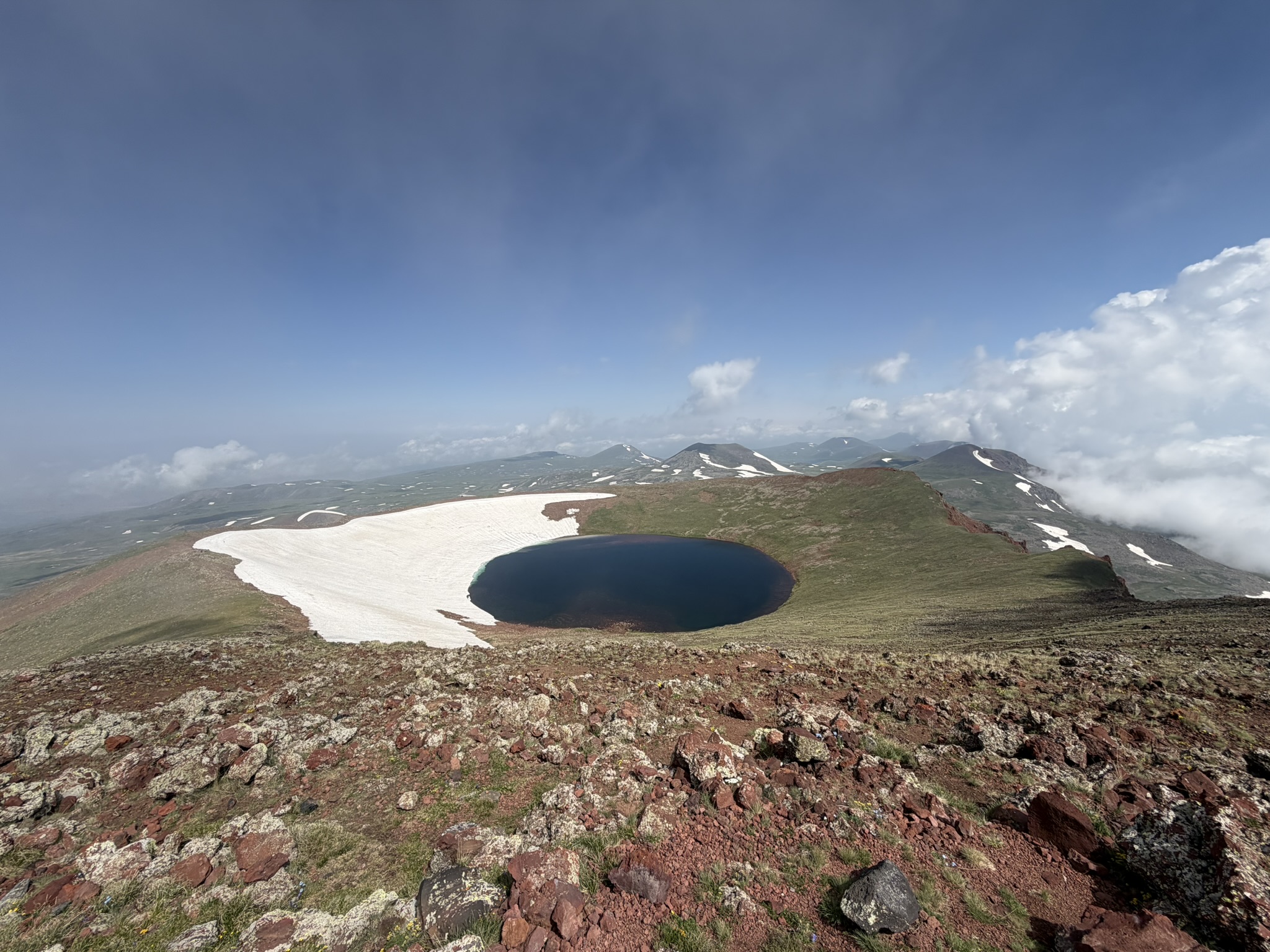
We reached the lip of the bowl above Badi lake and were blown away. A huge cornice wrapped around its edges and parts of it appeared to be precariously hanging on by a fingernail before it would release hundreds of meters down into the lake below. An original intent to target a camp on the other side of the pass beyond Azhdahak was readily abandoned and we spotted a shelf in the Duck lake basin to aim for instead. We both considered the risk of a tidal wave from a cornice fall. We set camp at 2pm in the afternoon and lounged about in the patchy sunshine.

Just as we set off for a quick jaunt to the lake itself, the clouds finally opened up on us just as we navigated a marsh formed from the retreating snowpack. While the rain ceased quickly, soon thereafter a grey, cold fog rolled in from the valley below and cloaked the basin entirely in midday darkness. Visibility was reduced to mere meters. I couldn’t believe it.
“Good thing we didn’t go for the pass. It’d be kinda f**ked up there right now”.
Soon after, an occasional belt of thunder rumbled about. Nestled in my down sleeping bag, I settled into reading of a collection of short stories by Oscar Wilde.
Always the optimist, the fog did lift before nightfall, and we were gifted a most beautiful of sunsets as we ventured again towards the lake.
As I drank my raspberry tea and meditated in awe on my surroundings, I had one of those moments.

The ones were you look around and say “F**k, yeah, dude. You’re really doing it.“
With enough grit, gumption, and accumulated self-confidence, dreams are merely precursors to pursued self-actualization. You just have to give them the oxygen and kindling to take fire and lay out the steps to make it lived reality.
In precisely that moment it really did dawn on me how easily it would have been to never have experienced any of this…
…Or any of the other prior two months of people and places I had come to know across the ten countries I had already traveled across in that time.
And how I now could not possibly imagine the alternative. Deep down I knew this was the only real choice to have made despite the lengthy deliberation prior to the start of it all – the path with heart.
How rational it would have been to stay the course with the comfortable, well-paid job in the town I knew with the people that respected me and the perfectly enjoyable life I made before this.
And how much effort it took to methodically set my life up to make all this possible, to take the final acts of courage to resign from my career, sign away the sublease to my cozy apartment, and board an airplane into the unknown.
And here I was now in Armenia, a country I had not even entirely planned to visit, surrounded by volcanic alpine lakes accented by snowfields and crowned with icy cornices in the company of a pack of wild dogs and another adventurous soul riding the same wave of life.
F**k yeah, dude.
This is the straight elixir of life.
I slept great that night.

Day 4
We rose again with sunrise and were delighted by clear, brilliant blue skies. We charted a pathless course west up the eastern slope of Azhdahak, navigating green ribbons of tufts of grass upwards through boulder fields until we reached the collar between the summit of Azhdahak and a sister peak south. From there, we dropped our packs and side-hiked up towards the summit and lapped around the volcanic rim and its crater lake. At one point, we thought we lost one of the dogs that excitedly went galivanting about along the snow encrusted cliff edge only to find it ahead of us again at the summit waiting for our arrival. The 360° panorama was stellar. You could hardly drink it all up. Our next camp destination at Lake Atna was visible to the north.

One of my favorite things about multi-day, long distance hiking is arriving at viewpoints were you can look to the horizon and chart precisely the landmarks that you had passed in the day before and look ahead to the ones that awaited you. The perspective and respect for time and space is profoundly rewarding.
On our descent down the lava field on the west side we spotted the first hiker we had seen in four days. When you hike deep into the backcountry, you might not meet many people, but when you do they are generally fascinating souls cut from the same cloth. Jakob was an Austro-German that had already hiked across Georgia on the TCT (he carried a full cache of crampons and ice axe in his pack) and skipped ahead to the Geghams to experience a bit of Armenia. We exchanged trail beta and life stories before wishing farewells. Funny enough, I would encounter Jakob again at the cargo ferry terminal in Azerbaijan several weeks later as we awaited the next ship taking foot passengers across the Caspian Sea to Kazakhstan.
From there onwards it felt as if the rest of our hike would be in chill mode. No more major passes or large snowfields to cross that may be exasperated by inclement weather. We marveled in the scenery as the route continued to chart its way from one volcanic cone to the next, passing the occasional crystalline lake along the way.
We soon reached Lake Akna, the largest lake in the Geghams, and took a late afternoon swim. We marched a bit further on and set up a delightful camp which kept the lake on the near horizon. All three dogs still bandied about hunting mice, and on cue, another thick fog rolled in to envelop our surroundings that evening. It later released in time for a splendid sunset but we then enjoyed a night of heat lightning, thunder, and occasional rain to lull oneself to sleep.
While we played cards during the initial rain, the German Shepherd took shelter in the vestibule of Kate’s tent. We had purposely avoided naming these dogs and refrained from thinking about what we would do with this one in particular at the end of the hike.

Day 5
On our last morning, I savored my morning coffee, balancing the melancholy of joy to soon reach a town, a shower, and hot food that is not packaged ramen, with the sadness of no longer discovering beauty at every turn of a river bend, summit of a mountain pass, or sip of tea at sunset.
It would be a long day, but all down hill. I did not expect as much eye candy having passed all the most prominent peaks and lakes at this point, but the final 27 km stretch towards Lake Sevan still delivered a most memorable day. The dying chain of volcanic mountain cones still stood proudly above their lowlands and the occasional spattering of remote orthodox chapels or shepherd camps sprinkled in the unique cultural element that this hike offered.
Kate began to inquire further what we should do with the German Shepherd when we got to town. Unlike the apparent wolf pups which seemed born into the wild and of whom we had visibly observed catching prey, the German Shepard appeared more benefitting of human hosts.
I told her that I had faith something would work itself out. When you travel in a way in which it feels like a movie script playing itself out, something always does. I just did not really know what that would be. Neither of us wanted the experience of walking into town and ditching the dogs as soon as we boarded a taxi and drove off.
In the early afternoon, I looked up from the trail and saw one of the dogs bolting off at a speed I hardly could believe with my own eyes as it flew across folds in the hills, its legs a blur beneath its fleeting body. Then I looked back at Kate and saw the two wolf pups and the German Shepherd still with us, momentarily. At that same instant, the wolf pups took off in the same direction as the fox, wolf, coyote, or whatever the hell it was, in hot pursuit.
…And then there was just one dog.
“Well, that solves part of the problem.”
We carried onward.

A couple hours later as we wound past the last of the diminishing peaks leading towards the shores of the great Lake Sevan, the route took us right through a shepherd camp. With only one dog now, and no cattle or sheep in immediate vicinity, we were less concerned as we passed through. A kind gentleman greeted us in exchanges of basic Armenian salutations. As we had nearly passed the camp, we heard him extend an offer for coffee.
I looked at Kate without saying a word but signaling with my eyes, yes, we are doing this.
The man led us up the steps into the rusted mobile trailer home where a fire roared in a stove in one corner, a tub of raw, butchered chicken cutlets laid out on another side and three kind elderly folk awaited us at a table overflowing with bread, sauces, sweets, meat, and potatoes.
I immediately felt in stride with my resurrected Peace Corps self. This shit was gold.
A hodge podge conversation of nearly non-existent English, broken Russian, Google translate Armenian, and hand signaling took root while coffee was served and plates piled high in local fare were presented in front of us. It was far more delicious than five day old salami, cheese, and stale store-bought lavash in my pack.

The eldest woman had silver hair and cutting blue eyes. She was Yazidi, a Kurdish minority that represented a significant portion of the nomadic shepherding community in the Geghams to this day. The other was Armenian. I understood them to be a mixed family through marriage. For the last 36 years they had been spending four months a year from June through September herding cows, horses, and sheep in the highlands here. What a life.
I then looked at Kate again.
“This is it.”
I began using Google translate to proposition the women in Armenian with taking our dog.
“It’s been following us for five days and more than 100km. It has climbed the third highest peak in Armenia with us. It is a good dog. It’s female, yes. But it’s a good dog. Would you like to have it?”
The women looked at each other. Then nodded their heads willingly.
“Ok, this dog will follow us when we leave. You will have to feed it as we walk away as a distraction. Understand?”
We finished lunch. I gave the family a premium Rittersport chocolate bar and bag of other packaged foods I had as an offer of appreciation for feeding us. They refused to accept it all, but took enough to acknowledge the gratitude.
Kate and I exited the trailer and hoisted our packs. The women threw bread at the dog that had been off frolicking about while we ate. We started walking.

“Don’t look back. Keep walking.”
We both nearly broke out in tears.
The dog was not following us. I was happy. I was also terribly sad. We couldn’t even say goodbye otherwise risk sabotaging the whole operation of the hand off.
“I told you it would work out. There is no better ending for that dog. It just walked 100km with us to find its home.”

—-
We unceremoniously arrived in the neighboring city to Sevan after walking past a solar power plant, a mine, a cement plant, and then a landfill. We hailed a taxi and got a ride to the Sevan peninsula for celebratory beers and Lake Sevan fish. Looking up from the lake side tiki hut where we were eating I almost had to laugh at the absurd juxtaposition of the tiki hut in the immediate foreground, a futuristic avant-garde Soviet-era hotel in the middle ground, and the 9th century Sevanavank Orthodox monastery on the hill in the background.

That’s some wild contrast.
Needing a place to stay, there was one clear obvious choice: the Soviet avant-garde Sevan’s Writer’s House it was. I may not have wholly trusted the weight bearing capacity of the balcony but the sunset views over the Lake Sevan were epic.
The next day we headed to the delightful mountain town of Dilijan for two nights and fit in one long day-hike on another section of the TCT to see the cliffs in the national park there. We then braced ourselves for another thrilling marshrutka ride several hours back to Tblisi, Georgia, to chill out for a few days before returning to the High Caucasus to hike the famous Mestia to Ushguli trek. Long days of beautiful, yet soulless landscapes accompanied by wild dog packs would now be behind us but remain memorable forever.


Leave a Reply